 Italiano
 English
 Français
 Deutsch

Selected venue:

Scuola Grande di San Rocco
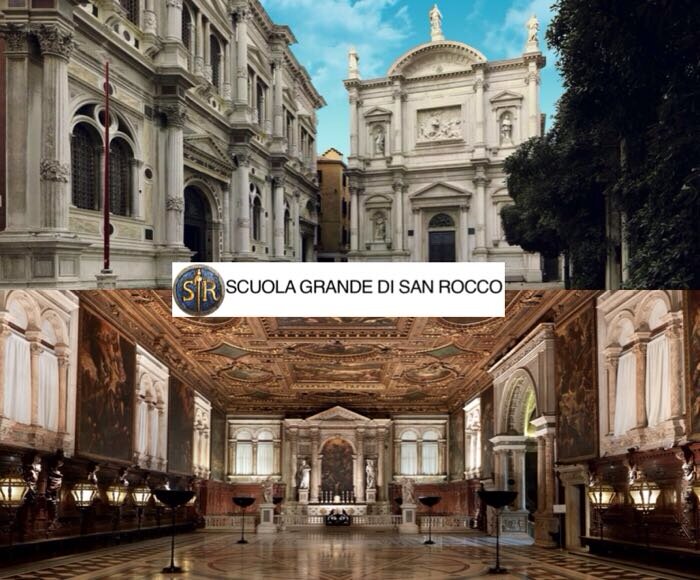
The Scuola Grande di San Rocco was born as the seat of a brotherhood of wealthy citizens, dedicated to charitable works. "Established in 1478 as a devotional school for the beaten under the title of St. Rocco, in 1489 it was already a Scuola Grande thanks to the increased number of brothers, for the merits acquired in alleviating public calamities and for the notable relic, brought here in 1485, of the body of St. Rocco, whose protection was invoked in epidemics, because this saint, a native of Montpellier (1295-1327), dedicated his life to assisting the sick. Indeed, inspired by a religious tradition, the Saint was depicted in the guise of a pilgrim in the act of showing the pestilential bubo, from which he had been struck during his pious office in Piacenza and from which he had been miraculously cured by an angel in a wood where he had retreated in the company of his faithful dog who brought him the necessary food every day. In 1515 the first stone of the grandiose building was laid, The construction of which lasted approximately fifty years. The Scuola stands next to the church of San Rocco, the saint to whom the city of Venice prayed for mercy during the first of the three great plague epidemics, that of the 15th century. Also dedicated to the patron saint of plague victims, the Scuola was erected on the site of the church of San Pantalon and the Basilica of Santa Maria Gloriosa dei Frari. On January 11, 1517, the project was entrusted to Pietro Bon (previously attributed to Bartolomeo Bon the Younger), who, however, had to adapt to the design already formulated by the Scuola's governing bodies. On June 3, 1524, he was replaced by Sante Lombardo, who in turn was replaced in 1527 by Antonio Abbondi, known as Scarpagnino, who completed the construction both inside—including the staircase and the sculptural decoration—and outside, where the upper floor was added and the entire façade was framed by columns. pilaster strips. The last was Giangiacomo de' Grigi, from 1558 to September 9, 1560. The design was similar to that of other Venetian Scuole and featured two rooms, one on the first and one on the second floor. The Sala Terrena consisted of three naves. This was the direct entrance to the campo. From this room, the upper room could be accessed via a "courtroom" staircase, interrupted by a domed landing. A destination for processions and a meeting place for the Confraternity, the upper room featured a wooden altar. From here, one then accessed the Sala dell'Albergo, where the Banca and the Zonta met. In 1489, the Scuole began construction of its own church, dedicated to San Rocco, which was consecrated in 1508.


